No other bird in America that has a date on the calendar?
There is probably no other bird in America that has a date on the calendar. Every November, millions of turkeys become the unofficial symbol of Thanksgiving, appearing on dinner tables, greeting cards, decorations, advertisements, and even at the White House. But the connection between turkey and Thanksgiving is older, stranger, and less straightforward than the familiar picture of a bird sitting proudly in the middle of a table.
The Traditions Behind the Celebration
The story usually begins with the harvest gathering at Plymouth in 1621, often described as the “first Thanksgiving.” There was certainly a large meal, and there is historical evidence that wildfowl was eaten. William Bradford also wrote about the settlers hunting wild turkeys that autumn. But there is no surviving menu showing that turkey was the centerpiece of the celebration, and some of the foods now considered essential to Thanksgiving were absent. Potatoes, for example, were not part of that meal, while venison, shellfish, corn, and other foods were likely among what was served. The modern Thanksgiving dinner would have looked quite different.
The turkey itself has an even more complicated history. Wild turkeys are native to North America, but the domestic birds familiar today ultimately descend from a population originating in Mexico. Indigenous peoples, including the Maya, had already been raising and using turkeys centuries before European colonization. Turkeys later crossed the Atlantic with Europeans and became established in European households before some settlers brought domesticated birds back to North America. By the seventeenth century, the bird was already familiar on both sides of the Atlantic.
Thanksgiving also did not begin as the fixed national holiday Americans know today. George Washington issued a proclamation in 1789 designating November 26 as a day of public thanksgiving, but subsequent observances varied in date and frequency. The holiday became a recurring national observance when Abraham Lincoln issued his 1863 proclamation calling for a day of Thanksgiving on the last Thursday of November. That development happened during the Civil War and was strongly encouraged by Sarah Josepha Hale, the influential editor who had spent years promoting a national Thanksgiving through her magazine, recipes, and correspondence with politicians.

Dude It’s Thanksgiving Scared Turkey Face Funny T-Shirt
Hale's influence matters because she helped shape not only the holiday itself, but also the idea of what Thanksgiving should look like. Through nineteenth-century magazines and cookbooks, recipes and menus helped turn a collection of regional customs into something closer to a shared national tradition. Turkey appeared prominently in this evolving Thanksgiving culture, although it was not immediately guaranteed a place at the center of every table. For a time, turkey competed with other meats such as duck, chicken, and goose. By the twentieth century, however, it had become increasingly dominant in Thanksgiving advertising and holiday cooking.
That transformation is one of the more interesting parts of the story. Traditions can feel ancient simply because everyone seems to know them, but familiarity does not necessarily mean great age. The Thanksgiving turkey is a good example. The bird itself is ancient, the harvest traditions are older still, and the 1621 gathering is genuinely historical. Yet the specific combination of Thanksgiving, a national November holiday, and a large roasted turkey at the center of the table was assembled gradually over generations.
White House acquired its own mythology?
Even the turkey’s relationship with the White House acquired its own mythology. Presidents have received Thanksgiving turkeys for decades, but the familiar presidential “turkey pardon” is much more recent than the holiday itself.
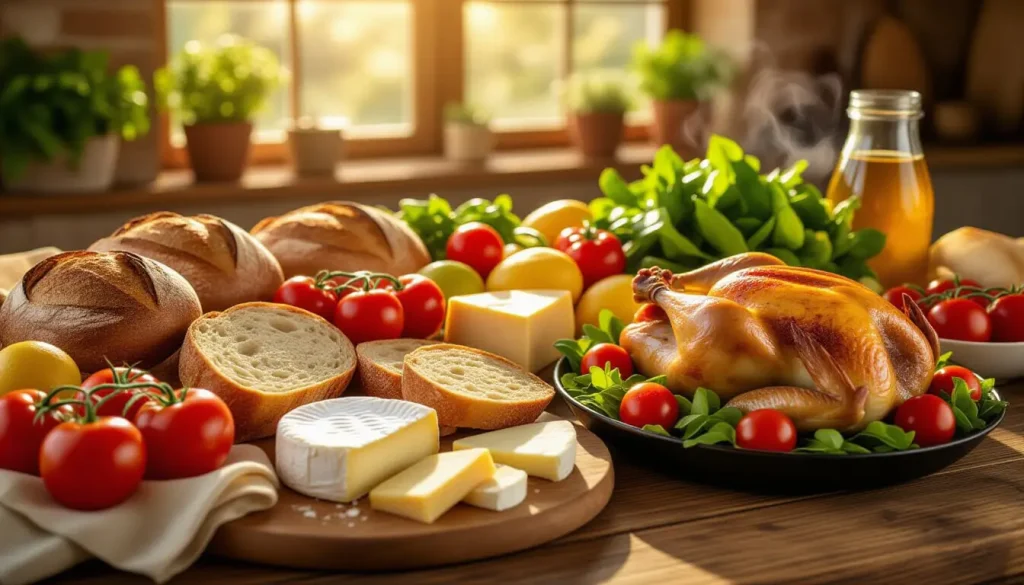
A turkey appears on a Thanksgiving table

Gobble Gobble Turkey Merry Christmas T-Shirt
Harry Truman received a Thanksgiving turkey from the National Turkey Federation in 1947, but there is no evidence that he established an official pardoning tradition. John F. Kennedy was the first president associated with the word “pardon” in connection with a Thanksgiving turkey, while George H. W. Bush formally used the phrase when he spared a turkey in 1989. Presidents have continued the practice ever since.
So when a turkey appears on a Thanksgiving table, it represents more than one old American tradition. It is the product of several histories meeting in one place: Indigenous knowledge of the bird, European domestication, colonial America, nineteenth-century publishing, national politics, advertising, and generations of family cooking. The familiar Thanksgiving turkey is not simply a survivor from the dinner at Plymouth. It is a tradition that was gradually built, repeated, promoted, and eventually made to feel inevitable.
Perhaps that is what makes the bird such an appropriate symbol for Thanksgiving. The holiday itself is a mixture of history and memory, documented events and stories passed down over time. The turkey belongs to that same complicated tradition. By the time it reaches the table each November, it has already traveled a remarkably long way.
And this is only one of the stories hiding behind the traditions we think we already know. Holidays, familiar symbols, old customs, and everyday rituals often have histories that are far less straightforward than they first appear. If the story of the Thanksgiving turkey made you look twice at something so familiar, there are plenty more waiting in The Journal, each one offering another detail, connection, or forgotten piece of history worth uncovering.


Read more interesting stories
The Saints Nobody Put on a Calendar
National Cat Day. What National Cat Day Is Actually For
National Chocolate Day. Eat the Bar, Then Read the Wrapper